
Front-end and back-end development form the foundation of modern web development, each playing a unique and essential role. Front-end development focuses on designing visually appealing, interactive, and user-friendly interfaces, while back-end development powers the functionality behind the scenes—managing servers, databases, and application logic.
Understanding how these two components differ, collaborate, and rely on specific technologies is key for businesses, developers, and tech enthusiasts aiming to build robust, scalable, and high-performing web applications.
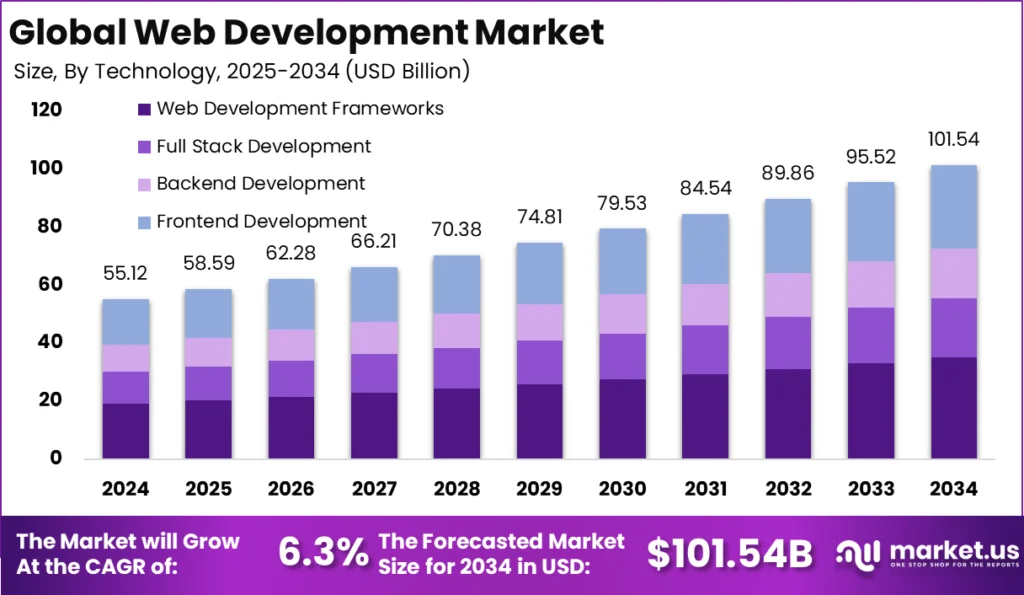
With the global web development market expected to reach USD 101.54 billion by 2034, selecting the right development approach has never been more critical.
As web applications become more complex and user expectations continue to rise, understanding how front-end and back-end development work together is essential. This knowledge enables businesses and development teams to make smarter decisions regarding technology selection, architecture, and overall project success.
Collaboration Between Front-End and Back-End
Front-end and back-end development are deeply interconnected. While the front end handles what users see and interact with, the back end ensures that everything functions smoothly behind the scenes. Seamless collaboration between the two is what creates a fast, reliable, and user-friendly application.
What is Front-End Development?
Front-end development, also known as the client-side, focuses on everything users directly interact with on a website or application.
This includes:
- Layout and structure
- Colors and typography
- Buttons, menus, and navigation
- Images, animations, and interactive elements
In simple terms, the front end defines how a website looks and feels.
To build these experiences, developers primarily use:
- HTML for structure
- CSS for styling
- JavaScript for interactivity
A key goal of front-end development is to ensure performance and responsiveness, meaning the website should work smoothly across all devices, screen sizes, and browsers.
Front-End Languages Explained
HTML (HyperText Markup Language)
HTML forms the backbone of any web page. It structures content using tags and defines how elements are displayed and connected across pages.
JavaScript
JavaScript brings websites to life. It enables dynamic behavior such as animations, form validation, and real-time updates, making user interactions smooth and engaging.
CSS (Cascading Style Sheets)
CSS controls the visual presentation of a website, including layout, colors, fonts, and responsiveness. It allows developers to create visually appealing designs independent of the HTML structure.
Popular Front-End Technologies
Modern front-end development relies on powerful frameworks and tools, including:
- React.js – A component-based library for building dynamic user interfaces
- AngularJS – A framework for developing scalable single-page applications
- Bootstrap – A popular toolkit for creating responsive designs quickly
- SASS – An advanced extension of CSS with added functionality
- jQuery – A lightweight library simplifying DOM manipulation and interactions
Other notable tools include Foundation, Semantic UI, Materialize, Backbone.js, and Ember.js.
Front-End Developer Skills
A front-end developer is responsible for transforming design concepts into interactive user experiences. Their work ensures that websites are not only visually appealing but also easy to use.
Key skills include:
- Building responsive and mobile-friendly designs
- Proficiency in HTML, CSS, and JavaScript
- Familiarity with frameworks, APIs, and CMS platforms
- Knowledge of testing and debugging techniques
Front-End Career Roles
User Interface (UI) Designer
Focuses on the visual design of applications, ensuring an attractive and intuitive interface.
Web Designer
Handles layout, aesthetics, and usability, sometimes working with design tools or directly coding in HTML and CSS.
User Experience (UX) Designer
Studies user behavior and improves the overall experience through testing and research.
Front-End Developer
Implements designs into functional interfaces using code, ensuring smooth performance and usability.
Front-End Developer Salaries
Front-end developers in the United States earn an average salary of around $115,000 per year, with additional bonuses in many cases.
Salaries vary based on:
- Experience level
- Location
- Company size
For example:
- Junior developers: ~$65,000/year
- Senior/Lead developers: ~$160,000+/year
Top-paying cities include Seattle, Columbus, and San Diego, where demand for skilled developers continues to grow.
What is Back-End Development?
When discussing front-end vs back-end, the back end refers to the server-side of a website or application. It is responsible for managing data, processing requests, and ensuring that everything on the front end works smoothly.
Unlike the front end, the back end is not visible to users. Instead, it operates behind the scenes, handling databases, server logic, and application functionality that users indirectly interact with through the interface.
Back-end development also involves working with system components, building libraries, and ensuring the application runs efficiently without relying on the user interface.
Back-End Programming Languages
Back-end systems can be built using a variety of powerful programming languages:
PHP
PHP is one of the most widely used server-side languages for web development. It is open-source, platform-independent, and works seamlessly across systems like Windows, macOS, and UNIX.
Java
Java is a highly reliable and scalable language used for web, mobile, and enterprise applications. Its strong ecosystem and long-term stability make it a popular choice for large-scale systems.
C++
C++ is a general-purpose, mid-level programming language known for its performance and flexibility. It is widely used across multiple platforms and in system-level programming.
Python
Python is a popular open-source language known for its simplicity and readability. It enables fast development and easy integration, making it a favorite among developers.
Node.js
Node.js is a runtime environment that allows developers to run JavaScript on the server side. It is widely used for building scalable, real-time applications and offers a rich library ecosystem.
Technologies Used in Back-End Development
Back-end development relies on a combination of tools and technologies, including:
- Web servers
- Databases
- Frameworks
- APIs
- Operating systems
Popular development stacks include:
- MEAN Stack (MongoDB, Express, Angular, Node.js)
- LAMP Stack (Linux, Apache, MySQL, PHP)
- .NET Stack
These stacks help developers build and manage server-side applications efficiently.
Popular Back-End Frameworks
- Django
- Express.js
- Ruby on Rails
- Spring
- Laravel
Other commonly used technologies include Ruby, REST APIs, and C#.
Back-End Developer Skills
Back-end developers focus on building and maintaining the server-side logic of applications. Their responsibilities include ensuring performance, security, and scalability.
Key skills include:
- Strong knowledge of programming languages and frameworks
- Database design and management
- Understanding of security and compliance
- API development and integration
- Basic knowledge of front-end technologies for collaboration
Career Opportunities in Back-End Development
Professionals in back-end development can pursue roles such as:
- Back-End Developer
- Full Stack Developer
- Software Engineer
- Java Developer
- DevOps Engineer
- iOS Developer
Some organizations also prefer full-stack developers who can handle both front-end and back-end responsibilities.
Back-End Developer Salary
Back-end developers generally earn higher salaries due to their critical role in application architecture.
- Average salary (USA): ~$153,000/year
- Range: $100,000 to $220,000+ depending on experience and location
For example:
- New York City: ~$156,000+
- Austin, TX: ~$128,000+
These figures highlight the strong demand for skilled back-end professionals.
Front-End vs Back-End: Key Differences
Front-end and back-end development are two sides of the same coin; they differ in function but are deeply interconnected.
- Front End: Focuses on design, layout, and user interaction
- Back End: Handles data, logic, and server-side operations
The front end is what users see and interact with, while the back end ensures everything works behind the scenes.
Choosing the Right Career Path
- If you enjoy design, layouts, and user interaction → Front-End Development
- If you prefer logic, algorithms, and system architecture → Back-End Development
- If you like both → Full Stack Development
Front-End vs Back-End Summary
| Aspect | Front End | Back End |
|---|---|---|
| Also Known As | Client-Side | Server-Side |
| User Interaction | Direct | Indirect |
| Languages | HTML, CSS, JavaScript | Python, Java, PHP, Node.js |
| Focus | UI/UX & Design | Logic & Data |
| Tools | React, Angular | Django, Node.js |
| Roles | UI/UX Designer, Web Designer | Back-End Developer, Engineer |
| Salary (USA) | $60K – $130K+ | $70K – $150K+ |
Conclusion
Front-end and back-end development are both essential for building modern web applications. While the front end ensures a smooth and engaging user experience, the back end powers the application with robust logic, data management, and security.
A strong understanding of both areas and how they integrate helps businesses and developers create scalable, high-performance applications.
As technology evolves, choosing the right combination of tools, frameworks, and strategies will be key to delivering efficient, future-ready solutions in 2026 and beyond.